De-centralised flower waste biorefinery: towards continuous supply of feedstock for the fine chemical industry

- Project lead
- Parimala Shivaprasad
- Institute
- University of Nottingham
Summary:
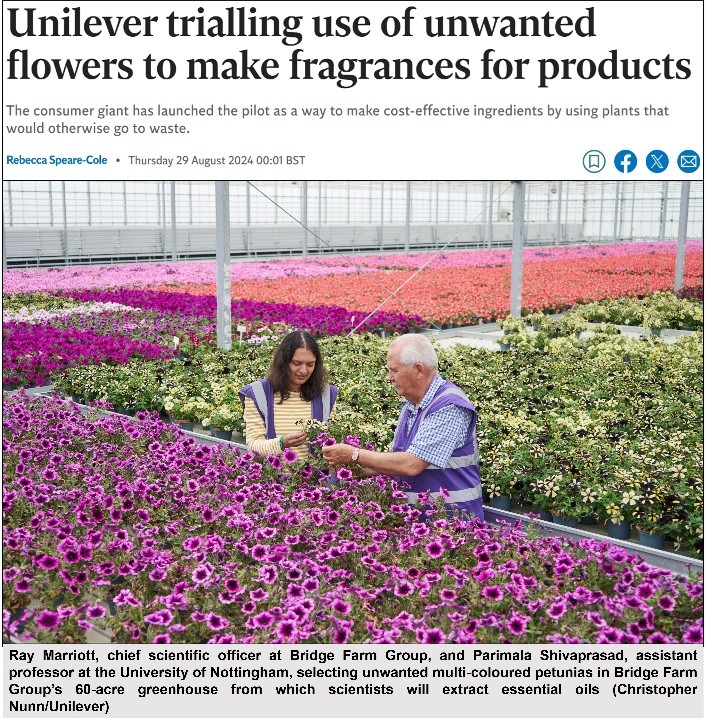
The billion-dollar flavour and fragrance industry accounts for 20% of the total global greenhouse gas emissions and changing regulations have prompted this industry to identify climate-neutral routes for manufacturing flavour and fragrance ingredients. Flowers are an abundant source of terpenes, which are highly versatile molecules that can be tailored into a range of starting materials for the fragrance, flavour and cosmetic products. This new collaboration with Unilever and the Bridge Farm Group (developed during BBNet and HVB workshops) will for the first time demonstrate the potential of flower waste as an alternative feedstock for personal and homecare product formulations. The aim of this project is to produce terpene esters from flower waste streams containing tulips, daffodils and roses using enzyme catalysis, demonstrate scale-up in a continuous reactor configuration and investigate the economic feasibility of flower waste as an alternative feedstock. Bridge Farm group (largest suppliers of ornamental flowers in the UK) produce approximately 1800 m3 of flower waste annually in the form of unharvested and unsold flowers. Unilever are aiming for a biomass-based signature fragrance for homecare products through their clean futures initiative. Hence, the project outcomes will create a new supply chain network for fragrance ingredients produced from valorising flower waste and accelerate a transition towards biobased chemical production by demonstrating enzyme catalysis at scale. The outcomes further align with the BBSRC and UK’s 2050 vision towards enabling utilisation of biomass and biotechnology to achieve sustainable manufacturing and net zero targets in the chemical industry.
Aims:
The aim of this project was to evaluate the feasibility of flower waste as an alternative feedstock to produce fragrance ingredients. These were unsold and unharvested flowers which are not purpose grown to extract fragrance ingredients, the key differentiator of this project compared to the existing, commercial supply chain for fragrance ingredients. The specific objectives of this project were to: (i) optimise ultrasound-assisted extraction of ‘crude’ flower oils and produce terpene esters enzymatically and (iii) evaluate economic feasibility and environmental impact of the flower waste biorefinery.
Outcomes:
This project demonstrated the technical and economic feasibility of converting floral waste into valuable fragrance ingredients. Flower waste, primarily consisting of unsold and unharvested flowers, was collected from UK horticulture operations and processed to extract oils using ultrasound-assisted technique. Extracts from seven flower types were profiled for odour quality and terpene content, identifying key candidates for fragrance applications.
An enzyme-catalysed process was developed to convert these crude extracts into terpene esters, which are widely used in fragrance and cosmetic formulations. Enzyme immobilisation methods were trialled to enhance process stability and reusability. The reactions were successfully carried out on multiple batches of flower extracts, confirming consistency and robustness.
The process economics were modelled by comparing extraction yields and quality with benchmark data from traditional sources such as rose oil. Several waste flower extracts showed competitive profitability over a 10-year period, particularly when high-value fragrance compounds were present. The extraction process was further optimised to maximise yield and minimise degradation of volatile components.
An environmental impact assessment model was developed to compare traditional fragrance production with a waste-based approach. Results showed that using waste flowers significantly reduces greenhouse gas emissions, avoiding the need for purpose grown cultivation of fragrance flower crops which are carbon intensive.
This work advances the readiness level of the technology and supports future development of modular, decentralised biorefineries. These systems could enable sustainable and local processing of floral waste, offering an alternative feedstock supply chain for the fine chemical industry and aligning with broader goals for low-carbon manufacturing.
Impact:
This project highlights a sustainable route for repurposing horticultural waste into high-value fragrance ingredients. It supports circular economy principles, reduces reliance on purpose-grown crops, and lowers environmental impact. The outcomes offer new opportunities for waste valorisation, contributing to greener supply chains in the home and personal care sectors.
Academic partners: Dr Parimala Shivaprasad, University of Nottingham, Dr Ioanna Dimitriou, University of Nottingham
Industrial partners: Dr Craig Jones, Unilever R&D