BlueYarn: bringing UK based seaweed fibres to the market
- Institute
- University of York
Summary
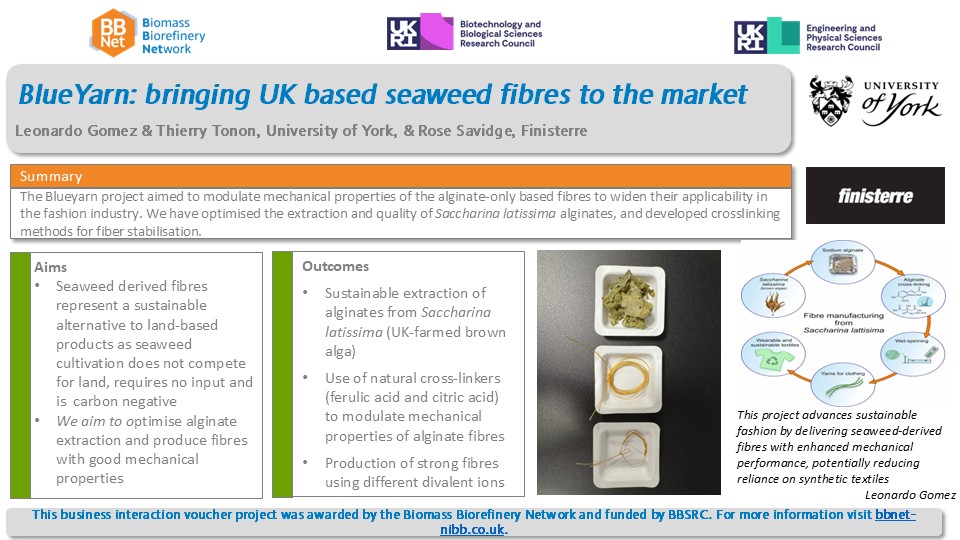
The fashion industry represents an estimated market of ~1.2 trillion GBP and is growing with a CAGR of ~5%. It is also one of the most polluting human activities, representing 10% of carbon emissions. One of the main reasons for this large environmental impact is the location of garment production in countries without appropriate regulation for waste disposal and with low labour costs. Although in recent years the demand for sustainable natural fibres has increased, the source and diversity of these is limited and in many cases the carbon footprint relatively high. Finisterre is a company based in Cornwall that develops innovative products including marine waste regenerated nylon, recycled polyester, and recycled cotton. Finisterre is collaborating with the Centre for Novel Agricultural Products (CNAP) to produce seaweed-based fibres that can be applied in the textile industry. Finisterre has a team of over 50 staff, a global eCom business, and 9 UK stores. Cornish Seaweed Company (CSC) has also been collaborating with CNAP to add value to seaweed biomass. CSC is an award-winning seaweed producer that is exploring the expansion of its products to target markets beyond edible seaweed. The company experiences increasing demand for seaweed derived products as alternatives to food, plastics and feed, but is hampered by a lack in technological ability to biorefine the raw biomass. The BlueYarn team has successfully established protocols for fractionation and for the extraction of alginates to produce sustainable functional fibres from brown seaweed. Our team has also developed protocols for the modulation of the mechanical properties of alginate fibres to expand its application range. However, given that alginate fibres are hydrophilic, their application in textiles is currently limited. This BIV will explore the development of alginate-based stabilised fibres, as well as the development of alginate composite fibres made with other bio-based polymers to develop local UK seaweed derived fibres with textile potential.
Aim
This project addresses the fashion industry’s need for sustainable alternatives to synthetic fibres. Seaweed-derived alginate fibres present a promising solution as seaweed cultivation is renewable, high-yielding, and non-competitive with food crops. However, their limited mechanical strength restricts use to niche products. The project aims to enhance and modulate the mechanical properties of alginate fibres to broaden their applications in fashion and to promote environmentally responsible material innovation.
Outcomes
The project successfully optimised alginate extraction from Saccharina latissima, producing high-purity, high-molecular-weight fractions suitable for fibre production. Wet spinning methods were established, yielding stable fibres with tunable strength and elasticity. Mechanical properties were enhanced through chemical crosslinking (citric and ferulic acids; BaCl2, SrCl2) and enzymatic strategies (tyramine/HRP system), demonstrating significant improvements in fibre strength. Composite fibres with cellulose further modulated elasticity. Alongside technical advances, fibre production and testing was set-up, two MSc students received training, and collaborations between CNAP, GCCE, CSC, and FINISTERRE expanded expertise and capability in UK sustainable bio-based textiles.
Impact
This project advances sustainable fashion by delivering seaweed-derived fibres with enhanced mechanical performance, potentially reducing reliance on synthetic textiles. It establishes scalable methods for fibre production, fosters cross-institutional collaboration, and trains new researchers.
The outcomes position alginate fibres as viable and eco-friendly materials, to support innovation and circularity in the textile industry.
Academic partner: Leo Gomez, University of York
Industrial partner: Rose Savidge, Finisterre and Tim van Berkel, Cornish Seaweed Company Ltd